Top 10 Python topics every developer should master
Python topics every developer should master for career growth, including file handling, decorators, logging, virtual environments, and more.
3 min read • 3/21/2026
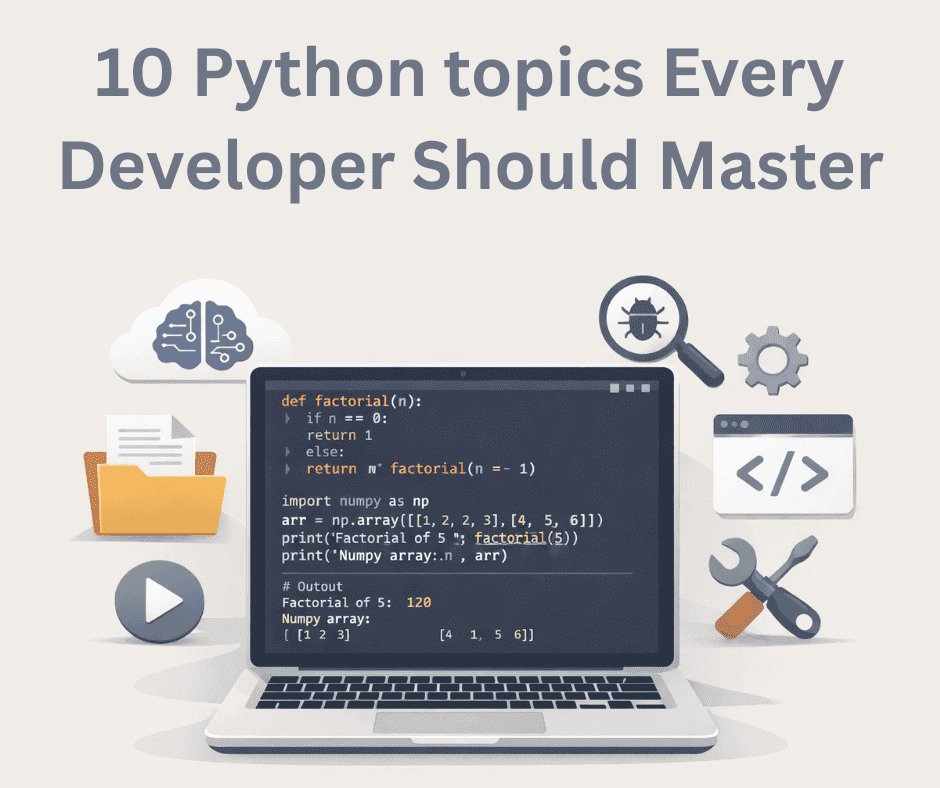
With the development of LLMs and AI agents, the software development process has been evolving lately. There are a variety of different programming languages catering to different needs, and one of them is the Python programming language.
Python is a simple, friendly-to-beginners, and very popular programming language. It is a multi-purpose programming language that finds applications in various sectors like web development, desktop development, machine learning, data science, automation, and many more. A majority of new learners decide to study Python initially due to its straightforward syntax.
Python is a very good choice for beginners. However, once you start exploring advanced concepts, you'll find it becoming more and more difficult. Nevertheless, mastering those advanced topics is a combination necessary and helpful for you to be capable of industry-level development. This post intends to unveil the top 10 Python topics every developer should master for career.
File Handling
File handling is a fundamental concept in Python. It is a technique that enables one to deal with files and is a tool to perform file operations, including but not limited to creating, reading, opening, writing, and closing files. It is a standard practice to save one's data in files through a program.
Exception Handling
Exception handling is a crucial and indispensible idea in Python. It assists you in controlling the program flow by dealing with unexpected errors resulting from invalid or unexpected inputs. It stops the program from abruptly crashing. Python uses the try-except keywords to perform exception handling.
Modules and Libraries
In Python, a module is a set of functions, classes, and methods that are created to accomplish common tasks. Meanwhile, a library is an assembly of modules. A module is generally a single file, but a library comprises several files and offers various features. Python offers different modules and libraries for a wide range of activities, from simple web development to machine learning.
List Comprehensions
List comprehension is among the key understandings of a Python developer. Simply put, it allows us to create a new list by applying a certain set of operations to each element of another list. We can write the whole thing very nicely, in a simple, clean, and readable manner. Besides that, the code generated by the list comprehension works more efficiently than the code generated by traditional loops.
Virtual Environment
Virtual environment is one of the most popular concepts in Python. If you are not aware of virtual environments, you should probably rethink the claim that you are a Python developer. It offers you a sandboxed Python environment where you can handle dependencies just for one project in isolation. It doesn't have an impact on other projects and it is a great way to avoid dependency conflicts among them.
Decorators
In Python, decorators give us the ability to change or add to the behavior of functions or methods without having to rewrite their original code. A decorator is basically a function that accepts one function as its argument and returns a new function which does basically the same thing but with some added features.
Logging
Logging means keeping a record of activities and the execution flow of a program. It helps developers to figure out what a program is doing and also makes it easier to trace the problems when the code is defective. In addition, logging is utilized to keep track of user activities in web development. A logging module that comes with the standard library of Python is very popular and extensively used.
Map and Reduce Functions
Python comes with powerful built-in functions like map and reduce. These functions are very helpful in changing and processing data efficiently. The map function takes a function and applies it to every item of an iterable and it returns a map object. While, the reduce function takes a function and applies it cumulatively to the items of a sequence thus returning a single value.
Lambda Function
Lambda functions are nameless, single-line functions that don't have a name and are very easy to define. A lambda function is defined by the keyword lambda and is generally used to perform simple and brief operations.
Any and All Methods
any() is a method that returns True if at least one item in the iterable is True. It returns False if the iterable is empty or if all items are False. It works like an OR operation on iterable objects.
all() is a method that returns True if all items in the iterable are True or if the iterable is empty. It returns False if at least one item is False. It works like an AND operation on iterable objects.
Conclusion
Python is a versatile programming language. For mastering Python, we suggest you should go in-depth with the topics mentioned above. Additionally, there are a few other major topics like OOPs and caching, that you can look into.
Being a Python developer with many years of experience, I would advise you to get a solid grasp of the basics first and then start working on projects. While doing the projects, you can slowly discover and understand advanced topics.
You Might Also Like
 Best Practices
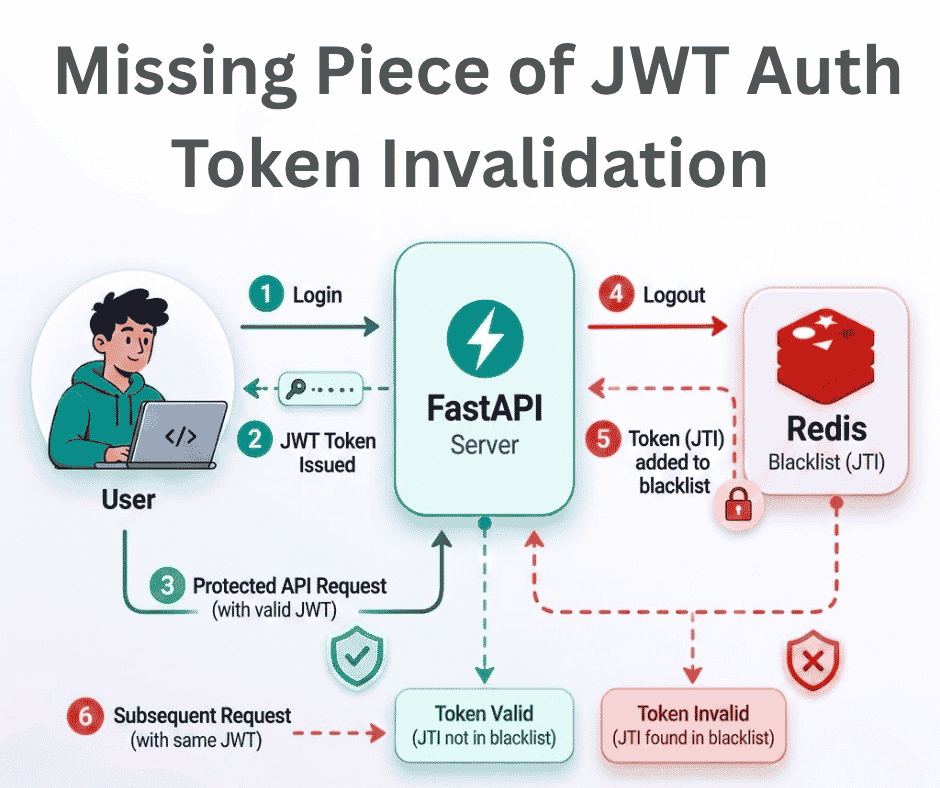
The Missing Piece of JWT Auth: Implementing Token Invalidation in FastAPI
JWT stands for JSON Web Token. It is an open standard that defines a compact and self-contained way to securely transfer data between two or more part
12 min read
 Backend & DevOps
How to improve MongoDB performance?
MongoDB is a NoSQL, document-based database used by developers for high-performance applications. It stores data in JSON-like format. As we all know,
2 min read
 Backend & DevOps
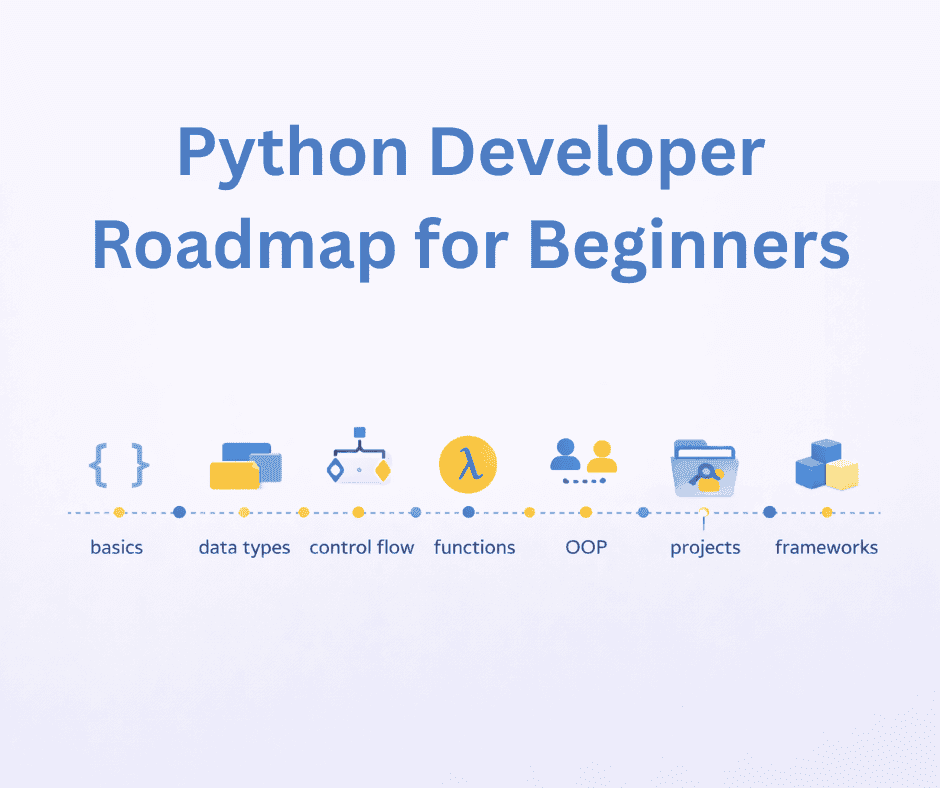
Python Developer Roadmap for Beginners
It is common knowledge that Python ranks among the most popular and extensively used programming languages globally, and this populari
8 min read