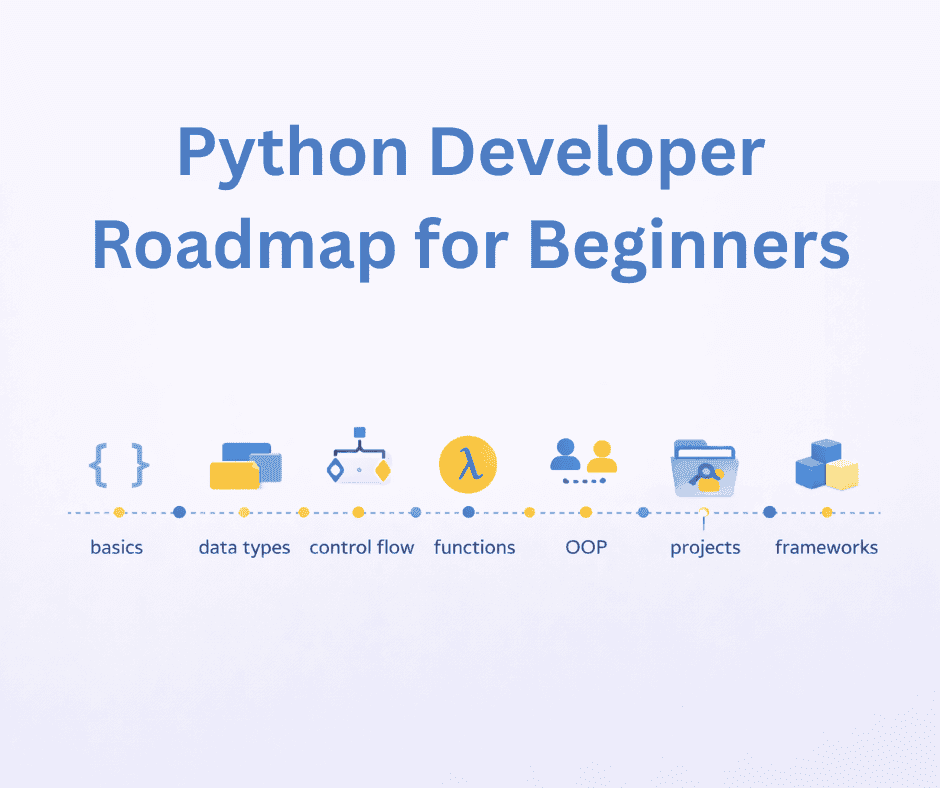
Python Developer Roadmap for Beginners
Discover the essential skills and technologies every beginner Python developer should learn to build a successful career in software development.
8 min read • 3/21/2026
It is common knowledge that Python ranks among the most popular and extensively used programming languages globally, and this popularity is certainly justified. In fact, it is a high-level, general-purpose language that anyone can use to develop a wide range of applications, from tiny automation scripts to massive, intricate systems. In case you are into any of the fields like web development, automation, machine learning, data science, web scraping, or DevOps, Python is certainly the way to go.
During the last several years, the fame of Python has increased at an unprecedented rate, with its use being heavily geared towards machine learning, artificial intelligence, and cloud-based workflows. Besides, its clean syntax and gentle learning curve make it an ideal choice for beginners, while the depth and flexibility of the language keep the more experienced developers hooked.
One of the main reasons why Python has managed to stay successful for so long is its vibrant community and expansive ecosystem. As a Python developer, the chances of you having to reinvent the wheel are very slim – most probably, there is a library or framework that has already been devised to help you solve the problem at hand. To mention just a few, from web frameworks like Django and Flask to data libraries like NumPy and Pandas, Python provides a great set of tools that make the whole development process efficient as well as fun.
Major companies like Intel, IBM, NASA, Netflix, and others are among those that extensively make use of Python in their operations. Their choice of Python is not simply due to the fact that it is easy to learn but rather also due to its comprehensive and robust library offerings, ability to scale and its reliability in handling real-life application situations.
If you have set your sights on becoming a Python developer, you can definitely spare yourself a lot of hours and sleepless nights by sticking to a well-defined and organized Python developer roadmap for beginners.
Introduction: What to Learn Before You Start Python
It is wise not to jump straight into learning the Python syntax without first understanding yourself with the fundamental concepts. In fact, getting a grip on the basics of how computers function and how software works can be a great leverage when learning Python, making the whole experience not only much easier but also more satisfying.
Begin by grasping the basics of how computer systems operate. There is no need to become a hardware specialist, but you should know what memory, storage, CPU mean and how programs run.
Then, understand the path of data through the internet. Get to know how websites operate, what happens when you enter a URL in a browser, and how clients and servers communicate. This understanding is a great asset if later you decide to deal with web applications or APIs.
It is of great help if you understand the basics of a web application and also difference between frontend and backend, and what happens during a request-response cycle.
Look at different operating systems (such as Windows, Linux, and macOS) and what makes them different in terms of file systems, process management, and command-line usage. This will make it easier for you to work in actual development environments.
It’s also essential to know the difference between a compiler and an interpreter. Python is an interpreted language, meaning the code is executed line by line instead of being compiled all at once. This understanding will provide you with a clearer picture of how Python handles your code and deals with errors.
After these basics are well understood, you can go ahead and install Python, learn its architecture, and compose your very first "Hello, World! " statement. This tiny step will be the start of your path as a Python programmer.
Basic Syntax
Once you have grasped the operation of computers and programs at a conceptual level, a logical progression would be to learn Python’s basic syntax. In fact, this is the very step in which you initiate actual coding.
First, acquaint yourself with variables and conventional naming standards. Knowing the right way to name variables will make your code not only understandable but also easier to maintain. Additionally, get to know how to write comments and docstrings because they are indispensable for your code documentation and for revealing the rationale behind a certain piece of code, i. e. what it is intended to accomplish, rather than just what it does.
You should also get to know Python keywords and adhere to best practices such as neat formatting, meaningful variable names, and a consistent style. Initially, these good habits may look trivial, but they are what distinguish a professional developer from a hobbyist.
Data Types
Data types are a contract between your program and the data it operates on. To a greater extent, Python comes equipped with a wide arsenal of built-in data types, and your mastery of them will greatly facilitate your journey in this programming language.
Begin with the fundamental data types like strings, integers, floats, and booleans, and familiarize yourself with their most frequently used methods. Afterwards, extend your knowledge to include collection types such as lists, tuples, sets, and dictionaries. These data structures form the backbone of real-world Python applications without exception.
You should also learn about type conversion (type casting), for example, turning integers into floats, strings into integers, and the other way around. Having the skill and the knowledge of when and how to switch data types is one of those safeguards that keep your program free of bugs and eccentric behavior.
Operators
Operators are the building blocks of programming - through them, we manipulate data.
First, consider the arithmetic operators and their hierarchy, but do not exclude from your study also comparison, logical, and assignment operators. Grasping the way operators interact with different data types will undoubtedly make your code more accurate and predictable.
At this point, you could probably start working on diminutive projects, like a rudimentary calculator, a number checker, or some basic automation scripts.
Input and Output
Input and output are the ways in which your program communicates with users and other systems.
Different printing and formatting output methods should be learned, including modern formatting techniques that make your output not only pretty but also clean and easy to read. Practice receiving user input, validating it, and doing something based on user input.
This is a level of program that the programs become interactive and very practical.
Control Structures
Control structures refer to ways how you can regulate your program's flow by making decisions, and performing desired actions repeatedly if necessary.
Start learning conditional statements "if", "elif", and "else". After that, delve into loops, particularly "for" and "while" including nested loops (loops within loops).
Learn when and why to use break and continue. Besides that, you should learn list comprehensions that are a very useful feature in Python to write concise and expressive code.
Functions
Functions allow you to tidy up your code and keep away from repetition.
A function is a section of code written to accomplish a particular objective. One should write the logic of the function once and reuse it wherever needed instead of writing the same logic numerous times.
Learn how to define functions and call them, pass parameters and arguments, and return values. Learn about variable scope and how Python handles local and global variables.
Discover lambda functions and decorators since decorators are most frequently used in Python frameworks and libraries. Besides that, learn how to write proper function documentation, which adds professionalism and clarity to your code.
Error Handling
Handling errors is very important for any programmer.
Find out how to use try–except constructions to deal with runtime errors in a more friendly manner. Know the common built-in exceptions and the situations when they are triggered.
One can also attempt. going beyond by making personal exceptions, learning simple debugging, and logging instead of print statements. Logging is used extensively in production-level Python apps and is a necessary skill.
Modules and Packages
As the scale of your work projects increases, it becomes necessary to structure your code.
Discover the workings of modules and how to make new ones. Get acquainted with different module importing techniques and delve into Python's standard library, which already provides solutions to many universal problems.
You also need to understand the concept of virtual environments and package managers like pip. Virtual environments are vital for dependency management, and the ability to use them is an absolute must-have skill for any serious Python developer.
Object-Oriented Programming (OOP)
Object-oriented programming is at the heart of most software nowadays.
So get to know classes and objects, and see how blueprints and instances relate to each other. Look at fundamental OOP concepts like inheritance, polymorphism, encapsulation, and data hiding.
Besides that, become familiar with constructors and special methods (dunder methods), as well as getters and setters. These ideas are used quite intensively in frameworks and huge codebases.
File Handling
File handling equips your software to manage data from the outside world.
Find out how to open and save documents in the simple txt as well as in more structured formats like csv and json. Take a look as well at working with binary files like pictures and videos.
Know everything about file paths, both absolute and relative, path joining, and handling folders. These capabilities come hand-in-hand with building backend systems and creating tools for automation.
Advanced Features
Once you are comfortable enough as a Python developer, it is time to check out the sophisticated aspects of the language.
Enhance your knowledge of decorators and the situations where they are used in practice. Get to know generators, iterators, context managers, and the with statement.
Moreover, you can have a deep dive into comprehensions and get to know functional programming concepts that are often used in Python.
Some Popular Libraries
Working with Python libraries allows you to become efficient in a shorter period of time.
You ought to get familiar with NumPy and Pandas since these two are the most popular tools for numerical calculations and data wrangling. Discover the Requests library, which is great for making HTTP requests and working with APIs.
These libraries are a part of real-life projects and are frequently listed as requirements for professional Python work.
What’s Next After Learning Python?
Once you are really comfortable with the basics of Python, making projects is the natural next step. Projects give you the opportunity to see how different concepts work together in real situations and also present you with the kinds of challenges that regular tutorials tend to overlook.
Initially, pick small projects and slowly keep on increasing their difficulty level. Try not to be too tricky, just focus on writing code that is clean, readable, and efficient. With the increase of your experience, you will somehow know how to make your code more efficient and follow better design principles.
Here you should make a decision about which way you would like to go.
Suppose you want to be a web developer; you can then start by learning about Python web frameworks like Django, FastAPI, or Flask, accompanied by different types of databases (SQL as well as NoSQL). All frameworks have their advantages so select one based on your aims and what you want to do in your projects.
If your intention is not to do web development, Python still has got you covered through its various other offerings like data science, machine learning, automation, DevOps, scripting, or backend systems. Find out about the frameworks and tools that match both your interests and your ideas for building something.
There isn’t only one “correct” way. Python is versatile, and so should be your roadmap.
Conclusion
Python ranks as one of the easiest programming languages when the consideration is beginners due to its pretty straightforward syntax and rich ecosystem. Still, being simple doesn’t equate to being limited. Python is the language behind some of the most intricate and large-scale systems worldwide.
The trick is to have a solid foundation before dealing with the more difficult stuff. It doesn’t make sense to memorize everything all at once. Pick one concept, give it your best shot through practice, then you’re ready for a new one.
Sometimes, it’s perfectly okay to be a bit lost in your thoughts. Learning how to program is a slow and steady thing, not a sprint. The key to success in this case is being consistent. Keep on learning, keep on creating, and most importantly—don’t quit.
Previous
Top 10 Python topics every developer should master
Next
JWT Authentication with Django Rest Framework
You Might Also Like
 Best Practices
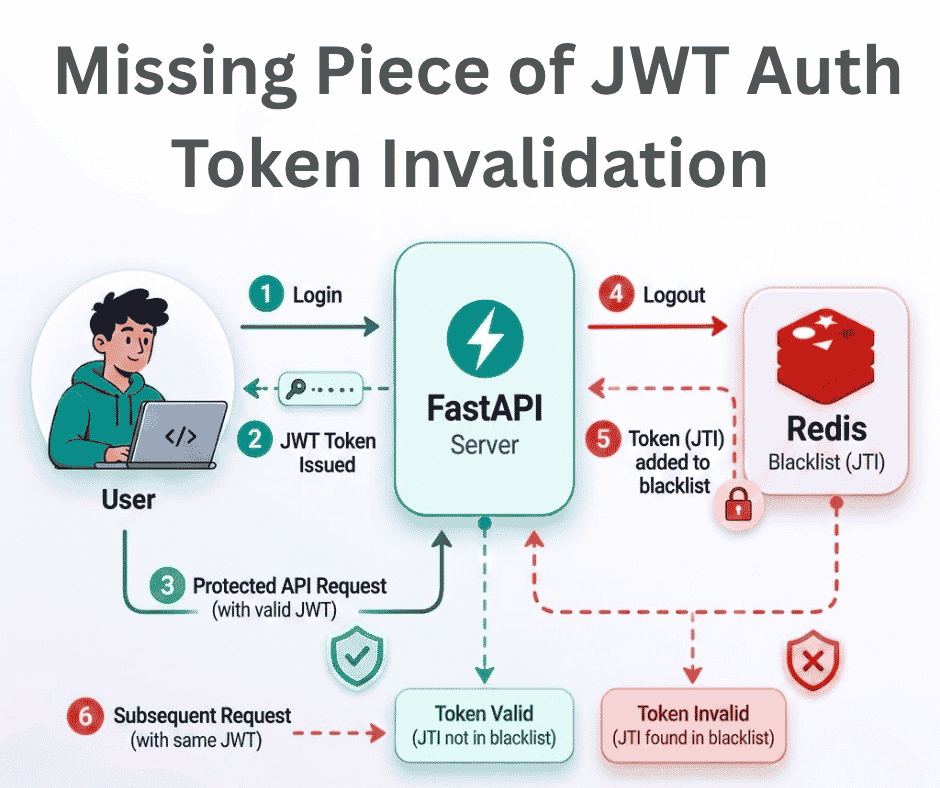
The Missing Piece of JWT Auth: Implementing Token Invalidation in FastAPI
JWT stands for JSON Web Token. It is an open standard that defines a compact and self-contained way to securely transfer data between two or more part
12 min read
 Backend & DevOps
Building and Deploying RustFS: S3 Storage Integration via Docker
Amazon Simple Storage Service (S3) is a popular object storage solution designed to help organizations build scalable, highly available, secure, and p
4 min read
 Backend & DevOps
High Performance Self-Hosted Bucket Storage for Developers
At scale, applications don’t store user-uploaded data such as images, videos, or other binary files directly in the database. Instead, this data is ha
6 min read