What are the interview questions for a Python developer?
Top interview questions for a Python developer. Master Python concepts, tips, and examples to ace your tech interview.
5 min read • 3/20/2026
Python is one of the most popular and widely used programming languages. It is a high-level, general-purpose programming language that supports systems ranging from basic to advanced level. Python supports web development, automation, machine learning, web scraping, data science, and more. In recent years, it has gained wide popularity due to it’s increased usage in machine learning and DevOps.
Python is popular because of its simplicity and strong community support. As a developer, you can find every libraries for almost every task. Python offers many tools and frameworks that make a developer’s life easier and more enjoyable.
The Python language is widely used by top companies such as Intel, IBM, NASA, Netflix, and others due to its powerful libraries. If you want to become a Python developer and want to crack an interview, the following are the interview questions for a Python developer. You need to master the following Python topics before attending the interview.
-
pass in Python
passis a keyword in Python. It is used in the codebase as a placeholder for future code. It helps avoid errors caused by empty code blocks.
For example, if you have anifcondition but the code for that condition is not yet defined and will be implemented in the future, you can use thepasskeyword so that the code runs normally without errors.
It is commonly used in function definitions, classes, conditions, and loops.
Example:age = 10 if age > 20: pass else: print("Sorry, we can’t admit you") def calc_time(): Pass -
Lambda Function in Python
Lambda functions are functions without a name and are also called anonymous functions. The
lambdakeyword is used to define a lambda function. It is a single line function where the expression is written in one line.Example:
sum_func = lambda x, y: x + y print(sum_func(2, 3)) even = lambda x: x % 2 == 0 print(even(10)) -
DocStrings in Python
DocStrings stands for Documentation Strings in Python. These are special strings used to document the code. They are usually used to provide information for classes, functions, and methods. DocStrings describe what a function does, its arguments, and its return type.
DocStrings are written using triple quotes ('''or""").
Example:def sum(x, y): """ This function sums two numbers. Args: x: Pass the first value as int y: Pass the second value as int Return: Returns the sum as int """ -
Shallow Copy and Deep Copy in Python
Shallow copy and deep copy are two concepts that are widely used in Python based on requirements.
Shallow Copy
A shallow copy in Python copies only the structure of an object and maintains references to the same objects in memory. If the object contains mutable elements (like lists inside a list), modifying those elements in the copied version will also affect the original object.
Example:
import copy
a = [1, 2, 3, 4, 5]
b = copy.copy(a)
In this case, since the list contains immutable values (integers), modifying
bwill not affecta.
However, if the list contains mutable objects, changes to those objects will affect bothaandb.Deep Copy
A deep copy creates a new instance of the original object along with all nested elements. There is no reference shared between the original object and the copied object.
Example:
import copy

a = [1, 2, 3, 4, 5]
b = copy.deepcopy(a)
Here, modifying
bdoes not affect the value ofa. -
Decorators in Python
Decorators are a method used to modify or extend the default behavior of a method or function without changing the original function. A decorator takes another function as an argument and returns a new function with modified functionality.
Example:
def decorator_logger(func): def wrapper(*args, **kwargs): print("Before calling the function.") res = func(*args, **kwargs) print("After execution.") return res return wrapper @decorator_logger def sum(a, b): return a + b print(sum(10, 20)) -
Iterator in Python
Iterators are Python objects that help iterate over items in collections such as lists, tuples, dictionaries, and strings. Iteration is handled using two key methods:
-
__iter__(): Returns the iterator object itself. -
__next__(): Returns the next value in the sequence and raisesStopIterationwhen it reaches the end.
Example:
data = "PYTHONFORDEVELOPER" iterator = iter(data) try: while True: print(next(iterator)) except StopIteration: Pass -
-
Generator in Python
In Python, generators are a special type of function that return an iterable object instead of returning all values at once. The
yieldkeyword is used to produce a sequence of results over time. Generators are memory-efficient because they pause the function’s execution at eachyieldand resume from that point when the next value is requested.
Example:def print_num(num): c = 1 while c <= num: yield c c = c + 1 for i in print_num(10): print(i) -
Pickling and Its Uses in Python
When you want to save an object or a certain instance to disk for later use, the concept of pickling is used. The
picklemodule is used for serializing and de-serializing Python object structures. Using this module, objects can be saved to disk and loaded back when required.Pickling is commonly used for serializing machine learning models, object sharing, and storing Python objects persistently.
Example:
import pickle dictionary = { "Site": "python for developer", "domain": "https://www.pythonfordeveloper.com", "Aspect": "Python" } with open("pickledic.pkl", "wb") as f: pickle.dump(dictionary, f) # Read with open("pickledic.pkl", "rb") as f: data = pickle.load(f) print(data) -
Static Method and Class Method in Python
Static Method
A static method is a method decorated with
@staticmethodthat converts a regular function into a static function. When a method is defined as a static method, it can be called without creating an object of the class. Static methods do not takeselforclsas a parameter.Example:
class PythonForDeveloper:
    site_name = "Python For Developer"

    @staticmethod
    def display_site_name():
        print(f"Site Name: {PythonForDeveloper.site_name}")


PythonForDeveloper.display_site_name()
Class Method
A class method is used to transform a regular method into a class-level method using the
@classmethoddecorator. It takesclsas a parameter and can be invoked directly using the class, without creating an instance.Example:
class PythonForDeveloper: count = 0 def __init__(self): PythonForDeveloper.count += 1 @classmethod def total_instance(cls): return cls.count p1 = PythonForDeveloper() p2 = PythonForDeveloper() print(f"Total Instance: {PythonForDeveloper.total_instance()}") -
__init__Method and__init__.pyFile in Python__init__MethodIn Python, the
__init__method is used to define the behavior of a constructor when a new instance or object is created. It is used to initialize values during object creation.Example:
class PythonForDeveloper: def __init__(self, site_name): self.site_name = site_name def get_site_name(self): return self.site_name py1 = PythonForDeveloper("PythonForDeveloper") py2 = PythonForDeveloper("Python For Developer") print(py1.get_site_name()) print(py2.get_site_name())__init__.pyFileThe
__init__.pyfile is created in Python to make a directory a Python module. It helps organize code as a module and is executed automatically when the module is imported. This file can also control which submodules are exposed when importing.Example:
# module1.py def mod1(): print("From Module 1")# module2.py def mod2(): print("From Module 2")# __init__.py from . import module1 from . import module2 __all__ = ["module1", "module2"] # Used to control what is exposed during import def mod2(): print("From Module 2")__init__.pyfrom . import module1 from . import module2 __all__ = ["module1", "module2"] # Used to control what is exposed during import
Conclusion
Python is a general-purpose programming language. It is beginner-friendly but also contains advanced concepts related to system design and architecture. The topics discussed above cover some advanced Python concepts that are commonly asked in technical interviews. We hope these topics will help you prepare effectively.
You Might Also Like
 Best Practices
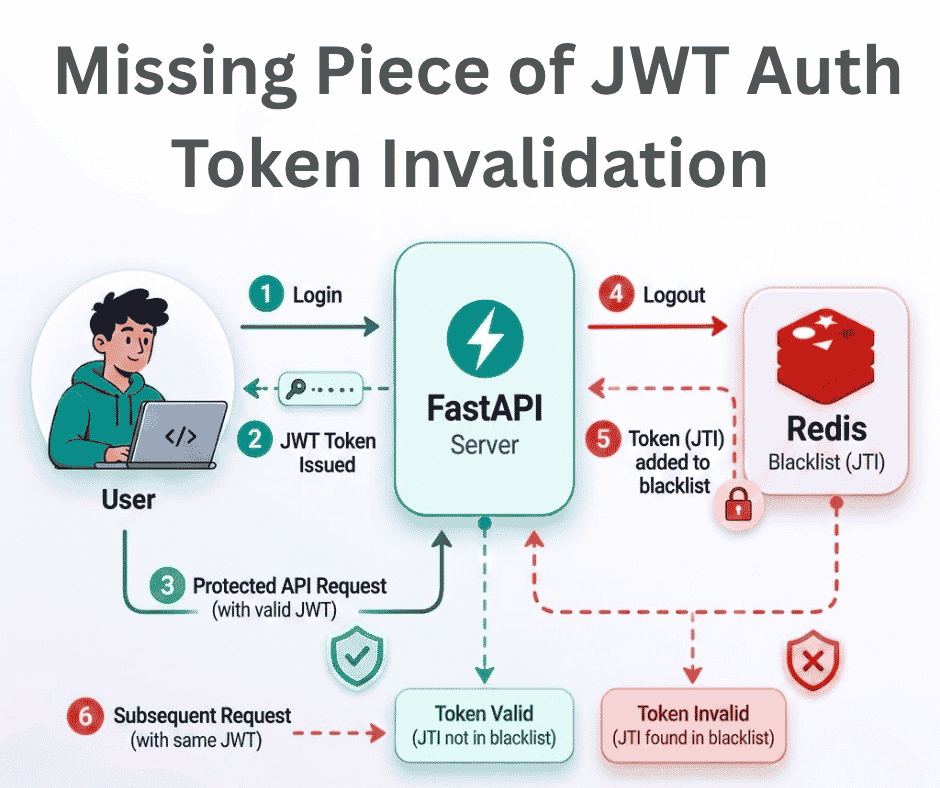
The Missing Piece of JWT Auth: Implementing Token Invalidation in FastAPI
JWT stands for JSON Web Token. It is an open standard that defines a compact and self-contained way to securely transfer data between two or more part
12 min read
 Backend & DevOps
How to improve MongoDB performance?
MongoDB is a NoSQL, document-based database used by developers for high-performance applications. It stores data in JSON-like format. As we all know,
2 min read
 Backend & DevOps
Python Developer Roadmap for Beginners
It is common knowledge that Python ranks among the most popular and extensively used programming languages globally, and this populari
8 min read